Why a Stock Can Rise Even When the News Looks Bad
You wake up and see terrible news about a company.
Maybe profits are down.
Maybe management has issued a warning.
Maybe the economy looks weak.
Maybe there is negative news all over social media.
You expect the stock to fall.
But then something strange happens.
The stock goes up. 📈
For many beginner investors and traders, this feels completely illogical.
“If the news is bad, why is the stock rising?”
The answer is simple:
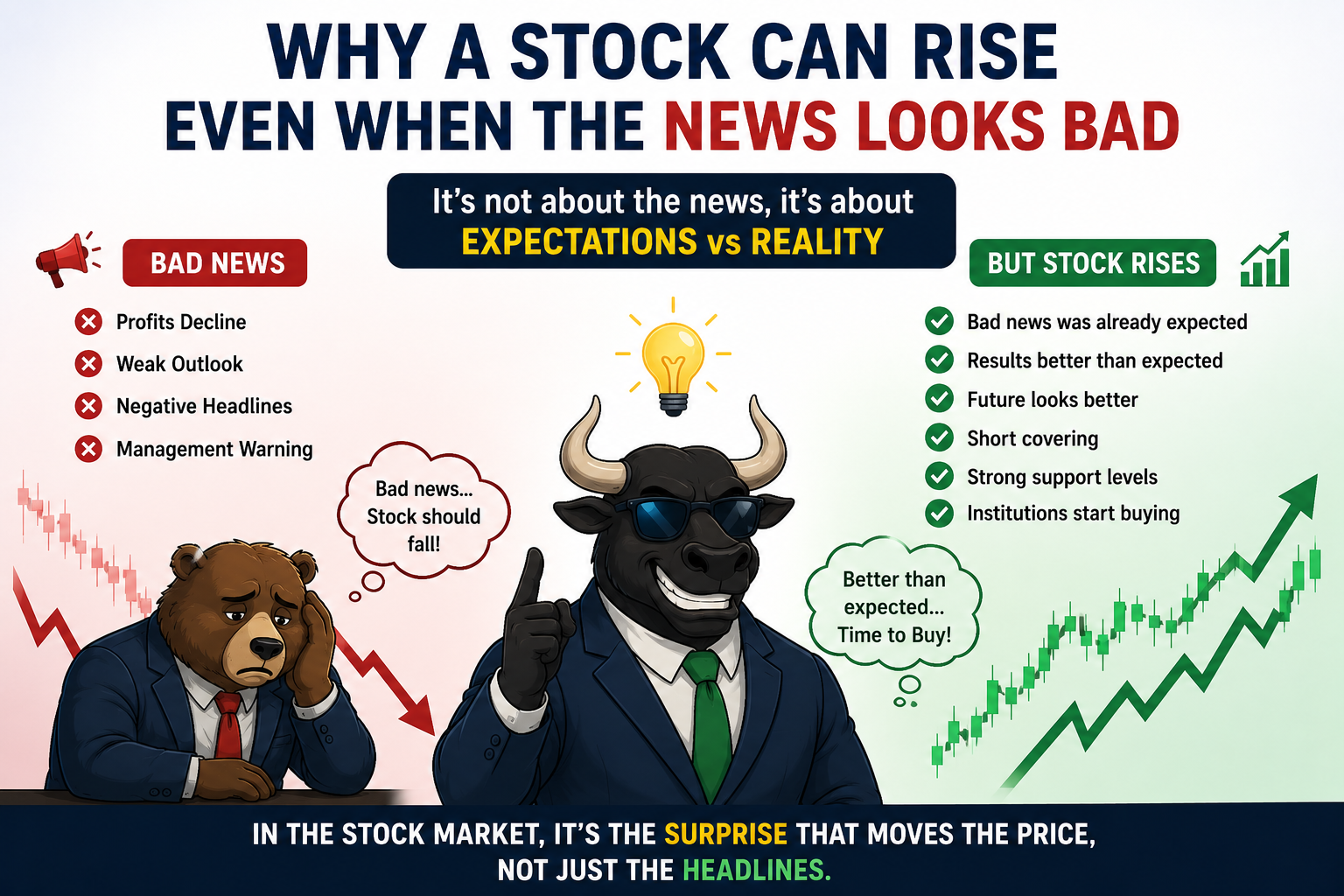
The stock market doesn’t move based only on whether news is good or bad.
It moves based on expectations, positioning, future possibilities, and the difference between what the market expected and what actually happened.
This is one of the most important concepts every trader should understand.
The Market Often Prices in the News Before You Read It
Imagine everyone already expects a company to report poor results.
For several weeks before the announcement, investors start selling.
The stock falls from ₹1,000 to ₹800.
Finally, the company announces bad results.
What happens next?
The stock may rise.
Why?
Because the bad news was already expected.
The market had already adjusted before the official announcement.
This leads to an important principle:
Markets react to surprises, not just headlines.
If the news is bad—but less bad than expected—the stock can rise.
Expectations Matter More Than Headlines
Let’s look at a simple example.
Scenario A
Investors expect a company’s profit to fall by 50%.
Actual result:
Profit falls by 20%.
Yes, the result is negative.
But it is better than expected.
The stock may rise.
Scenario B
Investors expect profit growth of 40%.
Actual result:
Profit grows by 10%.
The company is still profitable.
The numbers are positive.
But they are worse than expectations.
The stock may fall.
This is why:
Good news can lead to a falling stock.
And:
Bad news can lead to a rising stock.
Because the market is comparing reality with expectations.
“Buy the Rumour, Sell the News”
You may have heard this famous market phrase:
Buy the rumour, sell the news.
This happens when traders buy in anticipation of a positive event.
By the time the good news becomes official, many traders have already entered.
What happens next?
They start booking profits.
So even after good news:
The stock can fall.
The opposite can also happen.
Traders may sell aggressively before expected bad news.
Once the news arrives, there may be fewer sellers left.
The stock can then recover.
The Market Is Forward-Looking
One of the biggest mistakes beginners make is focusing only on the present.
Markets constantly try to estimate the future.
Investors may ask:
- Will earnings recover next year?
- Is the company’s worst phase over?
- Will interest rates decline?
- Can margins improve?
- Is management making the right changes?
- Is future growth still strong?
A company may report poor numbers today.
But if investors believe:
“Things will improve from here.”
The stock can rise.
Because the market may be pricing in the future rather than reacting only to today’s numbers.
Bad News Can Create Opportunity
Sometimes bad news causes panic selling.
A stock drops sharply.
But long-term investors may see value.
Imagine a fundamentally strong company facing a temporary problem.
The market reacts emotionally.
The stock falls significantly.
Large investors start buying because they believe the problem is temporary.
Demand increases.
The stock starts recovering.
This doesn’t mean every falling stock is a buying opportunity.
Some companies genuinely face serious problems.
The key is understanding the difference between:
Temporary bad news
and
Permanent damage to the business.
Short Sellers May Be Forced to Exit
Another interesting reason a stock can rise after bad news is short covering.
Imagine many traders expect bad results.
They already take bearish positions.
The bad news arrives.
But the stock doesn’t fall much.
Then the stock starts moving higher.
Short sellers may rush to close their positions.
To close a short position, they need to buy.
That buying can create additional upward momentum.
This is called:
Short Covering
Sometimes the move isn’t caused by new bullish investors.
It is caused by bearish traders exiting.
This is why understanding positioning can be important.
“Bad News” Is Not Always Bad for the Future
A headline can sound negative today but actually improve the company’s long-term situation.
For example:
A company announces:
- Cost-cutting
- Restructuring
- Exit from an unprofitable business
- Reduction of unnecessary expenses
- Write-offs
- Management changes
Initially, the headline may look negative.
But investors may interpret the decision as a positive long-term move.
Again, the market isn’t only asking:
“Is today’s news good?”
It is asking:
“What does this mean for the future?”
Institutional Activity Can Change the Direction
Markets are influenced by large participants.
Mutual funds, institutional investors, and other major market participants may have a completely different interpretation of the same news.
Retail traders may panic.
Large investors may accumulate.
Retail traders may see:
“Bad quarterly results!”
Institutional investors may see:
“The worst quarter may already be behind us.”
The same information can create completely different decisions.
This is why blindly following headlines can be dangerous.
Technical Levels Still Matter
Fundamental news and technical price levels can interact.
Imagine bad news arrives when a stock is already sitting near a strong long-term support zone.
The stock opens lower.
But buyers quickly appear.
The price recovers.
The final result may be a strong bullish candle.
The news was negative.
But the market’s reaction to the news was positive.
And that reaction can sometimes provide more useful information than the headline itself.
Watch the Reaction, Not Just the News
This is one of the most valuable lessons for traders.
Instead of only asking:
“Is the news good or bad?”
Ask:
“How is the market reacting to this news?”
For example:
Bad News + Stock Falls Sharply
The market may be treating the news as genuinely negative.
Bad News + Stock Remains Stable
Perhaps the news was already priced in.
Bad News + Stock Rises
The market may be interpreting the situation differently—or expectations may have been even worse.
The reaction provides context.
A Simple Framework for Understanding News
Before trading based on a headline, ask these questions:
1. Was the news already expected?
If everyone already knew about the problem, the market may have priced it in.
2. Is the result better or worse than expectations?
This can matter more than whether the headline sounds positive or negative.
3. What does the future outlook look like?
Markets often focus on future growth.
4. How is the price reacting?
Watch the actual market response.
5. Is there unusual volume?
High volume can indicate strong participation.
6. What was the stock already doing?
Was it already falling before the news?
Context matters.
A Simple Example
Imagine Company XYZ.
Before Results
Stock price: ₹1,000
For weeks, investors worry about falling profits.
The stock drops to ₹750.
Results Day
The company announces:
Profit declined by 15%.
The headline looks negative.
But investors expected a 30% decline.
The stock rises from:
₹750 → ₹820
Why?
Because reality was better than the market’s expectations.
The company still delivered negative growth.
But the surprise was positive.
That difference can move the stock.
Why Beginners Often Get This Wrong
Beginners often think:
Good News = Buy
Bad News = Sell
But markets are more complicated.
By the time news reaches everyone:
- Large investors may already know the possibility
- The price may have already adjusted
- Traders may already be positioned
- Expectations may already be extremely high or low
That’s why reacting instantly to every headline can lead to emotional trading.
The Market Can Be Irrational in the Short Term
Markets are made up of humans, algorithms, institutions, and different investment strategies.
In the short term, prices can move in unexpected ways.
Fear can create panic.
Greed can create rallies.
Positioning can create sharp moves.
Stop-losses can accelerate momentum.
Short covering can push prices higher.
This is why there is not always a simple one-line explanation for every price movement.
Don’t Fight the Price
As a trader, one dangerous mindset is:
“The news is bad, so this stock MUST fall.”
The market doesn’t care about what we think should happen.
Price can remain irrational longer than many traders expect.
If the market is moving against your assumption, respect your risk management.
Being correct about the news but wrong about the market reaction can still result in a loss.
The Smarter Approach
Instead of predicting the market based only on news, combine multiple factors.
Look at:
📊 Price Action 📈 Volume 📰 Expectations vs Reality 💰 Institutional Activity 📉 Market Trend 🎯 Support and Resistance ⚠️ Risk Management
No single factor tells the complete story.
The goal isn’t to predict every move.
The goal is to understand the probabilities.
Final Takeaway
A stock can rise even when the news looks bad because:
- The bad news was already priced in
- Results were better than feared
- Investors are focusing on future recovery
- Short sellers are covering positions
- Large investors are buying
- The market expected something even worse
- Technical buying appears at important levels
The most important lesson?
Don’t just read the news. Watch the market’s reaction to it.
Because in the stock market:
News tells you what happened. Expectations tell you what was anticipated. Price reaction tells you how the market actually feels.
And sometimes, that reaction can tell a completely different story from the headline.
The market doesn’t move based on whether news is simply good or bad.
It moves based on the gap between expectation and reality.
Final Thought 💡
The next time you see a stock rising after negative news, don’t immediately assume the market is wrong.
Ask yourself:
“Was the news really bad—or was it simply better than what everyone feared?”
That question can completely change how you understand market movements.