
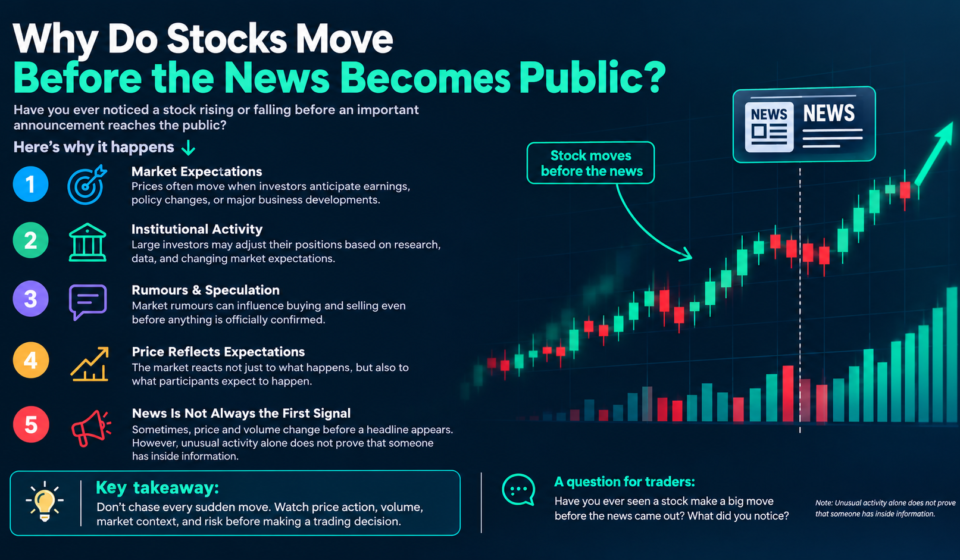


Have you ever noticed a stock rising sharply before a major announcement? Or watched a stock fall even before negative news appeared in the media?
It raises an interesting question: How can stock prices move before the public knows what is happening?
The stock market doesn’t wait for headlines to react. Prices change continuously as traders and investors evaluate expectations, economic data, company performance, and market sentiment.
Sometimes, the movement reflects informed analysis. Other times, it results from speculation, rumours, or ordinary buying and selling pressure.
Understanding these movements can help traders make more informed decisions instead of reacting emotionally to sudden price changes.
1. The Market Moves on Expectations, Not Just News
One of the most important principles of the stock market is that prices reflect expectations about the future.
Suppose a company is expected to report strong quarterly earnings. Before the official results are released, analysts may revise their forecasts, investors may increase their positions, and buying pressure may push the stock higher.
When the announcement finally arrives, the stock might rise further—or fall if the results are weaker than investors expected.
Think about this: If a company reports excellent profits but its stock price falls, does that mean the market is behaving irrationally? Not necessarily. Investors may have expected even better results.
The difference between expectations and actual results can be more important than the headline itself.
Question for readers: Have you ever seen a stock fall after announcing strong quarterly results? What do you think caused the decline?
2. Institutional Investors Can Influence Price Movements
Large institutions, including mutual funds, foreign portfolio investors, and other professional participants, often conduct extensive research before making investment decisions.
They may study company filings, industry trends, supply chains, economic indicators, and management commentary to estimate a company’s future performance.
When these investors gradually build or reduce positions, their orders can influence prices before a widely discussed event takes place.
However, institutional activity does not automatically mean that someone knows confidential information. Many price movements result from publicly available data and independent analysis.
Retail traders should avoid assuming that every large candle represents institutional buying or selling.
Question for readers: When analysing a stock, do you pay more attention to price action, volume, or institutional activity? Why?
3. Rumours and Speculation Can Move Stocks
Markets frequently react to expectations surrounding mergers, acquisitions, regulatory decisions, earnings announcements, and government policies.
Even unconfirmed reports can influence investor sentiment. Traders may buy because they expect positive news or sell because they fear a negative announcement.
But there is a major difference between market speculation and verified information.
A rumour can push a stock higher temporarily, only for the price to reverse when the expected announcement fails to materialise.
This is why chasing sudden price movements without understanding the context can be risky.
Question for readers: Should traders act on market rumours, or wait for verified information and confirmation from price action?
4. Price and Volume May Change Before a Headline Appears
Sometimes, traders notice unusual price or volume activity before an announcement becomes widely known.
For example, a stock might gradually move above a resistance level, attract increased trading activity, and continue rising before a company-related headline appears.
Possible explanations include changing expectations, reactions to public information, portfolio adjustments, or speculative trading.
Still, unusual volume is not proof that someone has access to confidential information. Price and volume alone cannot establish why a move occurred.
Instead of guessing the reason, traders can examine several factors:
- Price action: Is the stock breaking a key support or resistance level?
- Volume: Is trading activity higher than usual?
- Market context: Is the broader market or sector moving in the same direction?
- Risk management: Where would the trade idea become invalid?
These observations help traders evaluate a setup without pretending to know the future.
Question for readers: If a stock breaks resistance with rising volume but no major news, would you consider it a potential trading opportunity or wait for confirmation?
5. Public Information Does Not Reach Everyone at the Same Time
Even when information is publicly available, market participants may discover, interpret, and act on it at different speeds.
Professional investors may have sophisticated research systems, while individual traders may notice the same information later.
For example, an industry report, regulatory filing, or economic indicator could influence expectations before the story becomes widely discussed on social media or television.
This does not necessarily mean the information was secret. It may simply mean that some participants analysed available information earlier than others.
It is also important to distinguish this from trading on material non-public information, which can violate securities laws and regulations.
Question for readers: In your experience, do social media and financial news help retail traders understand the market sooner, or do they often react after a significant move has already happened?
6. Why Stocks Sometimes Reverse After the News
A common mistake among beginners is assuming that positive news always pushes a stock higher and negative news always sends it lower.
Markets are more complicated than that.
Imagine a company announces a major expansion. Investors may initially view the announcement positively. However, if the expansion requires substantial spending or creates uncertainty about future profits, the stock could struggle.
Another possibility is that traders bought the stock in anticipation of the announcement and begin taking profits once the news becomes public.
This behaviour is often described as “buy the rumour, sell the news,” although it does not happen in every situation.
The key lesson is to examine the announcement against market expectations rather than trading solely on whether the headline sounds positive or negative.
Question for readers: Have you ever bought a stock because of positive news, only to see its price decline afterwards? What did you learn from that experience?
7. What Should Traders Do When a Stock Moves Before the News?
You cannot know the exact reason behind every market movement. However, you can follow a structured process to reduce impulsive decisions.
Step 1: Observe before reacting. Avoid entering a trade simply because a stock is moving quickly.
Step 2: Check the chart. Identify important support and resistance levels, trend direction, and possible breakout or reversal patterns.
Step 3: Compare volume. Determine whether trading activity is unusual relative to the stock’s normal volume.
Step 4: Verify information. Look for official company announcements, exchange disclosures, and reliable sources instead of relying on unconfirmed rumours.
Step 5: Define your risk. Establish your entry conditions, exit plan, and acceptable loss before taking a position.
Step 6: Accept uncertainty. A strong-looking chart pattern does not guarantee that a stock will continue in the same direction.
Good trading is not about predicting every announcement. It is about evaluating available evidence and managing risk when the outcome is uncertain.
Final Thoughts
Stocks can move before news becomes widely known because markets continuously adjust to expectations, research, speculation, public information, and buying or selling pressure.
Sometimes, the market anticipates an event correctly. At other times, traders misjudge the situation, and prices reverse sharply when new information arrives.
The most important lesson is simple: A price movement is a signal to investigate, not proof that you know the reason behind it.
Rather than chasing every sudden candle, focus on price action, volume, reliable information, and disciplined risk management.
Let’s Discuss: Questions for Traders
I’d love to hear your thoughts on these questions:
- Why do you think some stocks rise before positive news is officially announced?
- Can price action reveal changing market expectations before a headline appears?
- Have you ever witnessed a stock make a major move before an announcement? What happened afterwards?
- Do you believe retail traders can identify early market signals without relying on rumours?
- What matters more to you when analysing a stock: price action, volume, news, or fundamentals?
- What is the biggest mistake traders make when reacting to breaking news?
Share your experience in the comments. Your observation could help another trader understand the market from a different perspective.
Disclaimer: This article is for educational purposes only and should not be considered investment advice or a recommendation to buy or sell any security.


