


Have you ever opened your trading platform, looked at dozens of stocks, and felt confused about which one to trade?
You are not alone.
Many traders spend hours searching for opportunities but still end up taking random trades. They jump from one stock to another, follow social media tips, or enter a position simply because a stock is moving quickly.
The problem is not always a lack of market knowledge. Sometimes, it is a lack of preparation.
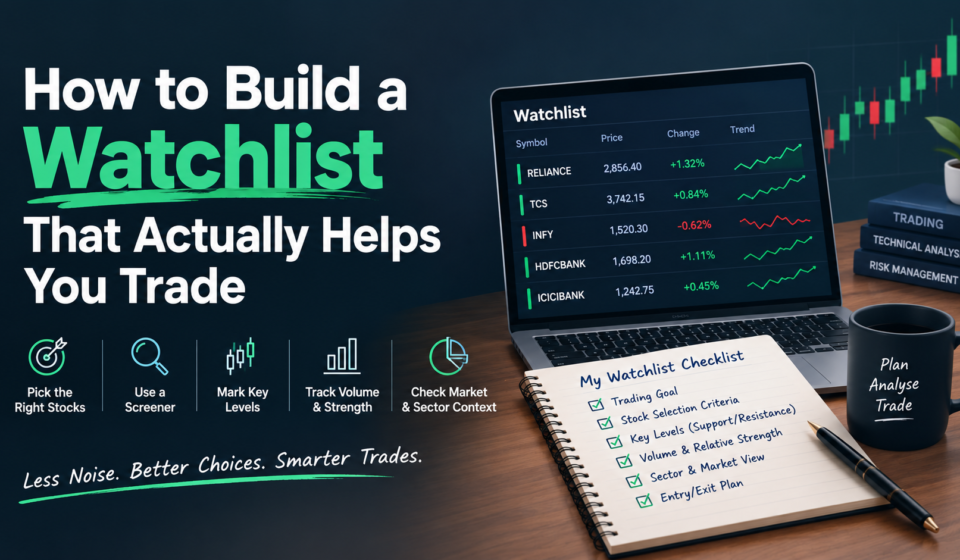
A well-organised watchlist can help traders focus on better opportunities, avoid unnecessary distractions, and make more disciplined decisions.
But a useful watchlist is not just a collection of popular stocks. It is a carefully selected group of stocks that you understand, monitor, and evaluate according to your trading strategy.
Let’s explore how to build one that actually helps you trade.
1. Start With a Clear Trading Goal
Before adding stocks to your watchlist, ask yourself one important question: What type of trading do I want to do?
Different trading styles require different approaches.
- Intraday trading: Focus on stocks with sufficient liquidity, meaningful price movement, and clear intraday setups.
- Swing trading: Look for stocks showing potential trends or technical patterns that may develop over several days or weeks.
- Positional trading: Focus on broader trends, company fundamentals, and important market developments.
- Options trading: Monitor the underlying stock or index, its volatility, liquidity, and relevant options-market conditions.
Trying to follow every stock for every trading style can create unnecessary confusion.
For example, an intraday trader may prioritise stocks with strong relative volume and clear breakout levels, while a swing trader may focus on daily-chart trends and support zones.
Question for readers: Which trading style do you prefer—intraday, swing, or positional trading? How does it influence the stocks you follow?
2. Focus on Quality, Not Quantity
One common mistake beginners make is adding too many stocks to their watchlist.
They may monitor 50 or even 100 stocks, hoping to catch every possible opportunity. However, tracking too many charts can make it difficult to understand price behaviour and recognise meaningful setups.
Instead, start with a manageable list of around 10–20 stocks. You can adjust this number based on your experience, available time, and strategy.
Choose stocks that meet your basic criteria, such as:
- Sufficient trading liquidity.
- A price range suitable for your trading plan.
- Consistent trading activity.
- Clear technical levels or identifiable trends.
- Relevant sector or market strength.
The goal is not to find a trade in every stock. It is to identify the few stocks that offer setups worth monitoring.
Remember, more stocks do not automatically mean more opportunities. Sometimes, fewer well-understood stocks lead to better decisions.
Question for readers: How many stocks do you currently track in your watchlist? Do you think a smaller list makes trading easier?
3. Use a Stock Screener to Find Potential Candidates
A stock screener can help you filter a large market into a smaller group of potential candidates.
Instead of checking every stock manually, define criteria based on your strategy.
For example, an intraday trader might look for:
- Stocks with relatively high trading volume.
- Stocks showing strength or weakness compared with the broader market.
- Stocks approaching important support or resistance levels.
- Stocks reacting to verified news or company announcements.
- Stocks with sufficient liquidity for planned entries and exits.
A swing trader may use different filters, such as stocks trading above important moving averages, showing higher highs and higher lows, or approaching a breakout level.
However, screeners only identify candidates. They do not confirm that a trade is suitable.
A stock appearing on a screener should still be checked against your trading setup, market conditions, and risk limits.
Question for readers: Do you use stock screeners to build your watchlist, or do you select stocks manually? Which method works better for you?
4. Identify Important Support and Resistance Levels
Once you select a stock, the next step is to understand where its price is trading in relation to important technical levels.
Support is an area where buying interest has previously emerged, while resistance is an area where selling pressure has previously appeared. These levels are zones of potential interest, not guaranteed turning points.
For example, suppose a stock is trading near ₹500 and has repeatedly struggled to move above ₹520.
You could add it to your watchlist with a note:
- Current price: ₹500.
- Resistance zone: Around ₹520.
- Support zone: Around ₹485.
- Potential setup: Watch for a breakout, rejection, or consolidation near these zones.
You do not need to enter immediately. You simply know what you are waiting to observe.
This approach turns your watchlist into a preparation tool rather than a list of prices to chase.
Question for readers: When building a watchlist, do you mark support and resistance levels in advance, or do you identify them only after the market opens?
5. Track Volume and Relative Strength
Price alone does not always provide enough information.
Volume helps you understand how much trading activity is taking place. Comparing current activity with typical volume can reveal whether a move is attracting unusual participation.
For example, if a stock breaks above a resistance zone with stronger-than-usual volume, it may deserve closer attention. However, a breakout can still fail, so confirmation and risk management remain important.
Relative strength is another useful concept. It describes how a stock performs compared with a benchmark or its sector over a given period.
Imagine the broader market is falling, but one stock is holding steady or rising. That relative strength may make the stock worth monitoring.
Similarly, a stock falling more sharply than its sector may deserve attention from traders looking for weakness.
Neither volume nor relative strength guarantees future price movement. Use them alongside your strategy rather than treating them as standalone buy or sell signals.
Question for readers: Which indicator do you find more useful when selecting stocks for your watchlist—volume, relative strength, RSI, or moving averages? Why?
6. Include Market and Sector Context
A stock does not move in isolation.
Broader market trends, sector performance, interest rates, economic data, and company-specific developments can all influence price behaviour.
For Indian market participants, monitoring relevant benchmarks such as the Nifty 50 and Nifty Bank, along with the stock’s sector index, can provide useful context.
Suppose a banking stock is approaching resistance. Before deciding whether to monitor a potential breakout, you might check whether the banking sector is also showing strength or whether the broader market is under selling pressure.
Sector alignment does not guarantee success, but it can help you understand whether a stock’s move is supported by a wider trend or appears relatively isolated.
Also, be aware of scheduled events such as earnings announcements and major economic releases, which can increase volatility.
Question for readers: Before trading an individual stock, do you check the broader index and sector performance? Has this changed the way you approach a trade?
7. Create a Simple Watchlist Template
A watchlist becomes more useful when you record why each stock is on the list and what conditions you are waiting for.
You can start with a simple spreadsheet or a watchlist feature in your trading platform.
Here is an example using hypothetical prices for educational purposes.
| Stock | Key level | Observation | What to watch |
|---|---|---|---|
| Stock A | ₹520 resistance | Price approaching resistance | Breakout confirmation |
| Stock B | ₹485 support | Price holding near support | Signs of support holding |
| Stock C | ₹700 | Stronger than its sector | Continuation or reversal |
| Stock D | ₹350 | Volume increasing | Whether price confirms the move |
These examples are illustrative, not live market data or trading recommendations.
You can also include columns for current price, average volume, trend direction, planned entry condition, invalidation level, and notes.
The most important column is often “What am I waiting for?”
It forces you to define a reason for monitoring a stock instead of reacting to every price movement.
8. Review Your Watchlist Before and After the Market
Building a watchlist is not a one-time activity. Market conditions change, and yesterday’s strongest candidates may no longer be relevant today.
Before the market opens, review your selected stocks, identify important levels, and check for scheduled company announcements or major market events.
During the session, monitor only those stocks that are approaching your predefined conditions. Avoid entering trades simply because a stock appears in your watchlist.
After the market closes, review what happened.
Ask yourself:
- Did the stock reach the level I was watching?
- Did the expected setup develop?
- Did volume support or contradict the price movement?
- Was the setup invalidated?
- Did I follow my plan, or did I react emotionally?
Remove stocks that no longer fit your criteria and add new candidates only when they meet your selection rules.
This process helps your watchlist remain focused and relevant.
Question for readers: Do you prepare your watchlist the night before, before the market opens, or during live trading?
9. Common Watchlist Mistakes to Avoid
Even a carefully prepared watchlist can become ineffective if you use it incorrectly.
Adding stocks because they are trending on social media: Popularity alone does not make a stock suitable for your strategy.
Following too many stocks: Excessive monitoring can lead to distraction and impulsive entries.
Ignoring liquidity: A stock may look attractive on a chart but still be difficult to trade efficiently.
Treating every breakout as a signal: Breakouts can fail, and technical levels are not guarantees.
Never removing stocks: A watchlist should evolve as market conditions and your selection criteria change.
Confusing observation with action: A stock can be worth watching without being worth trading.
The purpose of a watchlist is to improve preparation and selectivity—not to force you to trade every day.
Final Thoughts
A useful watchlist helps you answer three important questions:
- Which stocks deserve my attention?
- What specific price behaviour am I waiting for?
- Under what conditions will I avoid or exit a trade?
You do not need dozens of stocks, complicated indicators, or constant screen time to build a practical watchlist.
Start with a clear trading style, select a manageable number of liquid stocks, mark important levels, monitor volume and market context, and review your decisions regularly.
Over time, this routine can help you become more organised, reduce unnecessary distractions, and approach trading with greater discipline.
Remember: Your watchlist should help you wait for the right setup, not give you a reason to trade every stock.
Let’s Discuss: Questions for Traders
I’d love to hear your experience in the comments:
- How many stocks should a beginner keep in their watchlist?
- What is the first thing you check before adding a stock to your watchlist?
- Do you prefer selecting stocks through technical analysis, fundamental analysis, or stock screeners?
- Which indicators do you find most useful for identifying potential trading opportunities?
- Do you prepare your watchlist before the market opens or during the trading session?
- What is the biggest mistake you have made while managing your watchlist?
- If you could track only five stocks for a month, how would you choose them?
Share your approach in the comments. Your experience might help another trader build a more disciplined routine.
Disclaimer: This article is for educational purposes only and does not constitute investment advice or a recommendation to buy or sell any security.

